
Nairobi has no harbour, no river mouth and no old town. It exists because in 1899 a construction crew driving a metre-gauge line inland from the coast reached the last stretch of flat, well-watered ground before the Rift Valley escarpment and stopped there to build a depot. The ministries, the hotels, the grid of downtown streets and the settlements strung along the embankment all grew outward from that single logistical decision. The line that caused it is still in the ground, still carrying freight, and still walkable in places if you know which ones.
Why a depot became a capital
The Uganda Railway was begun at Mombasa in 1896 and pushed inland toward Lake Victoria and on into Uganda. Debated in Westminster as an extravagance and nicknamed the Lunatic Line, it was in engineering terms a supply problem: a metre-gauge track needed water, level ground and workshop space at regular intervals, and the swamp the Maasai called Enkare Nyirobi (cold water) offered all three at the right distance before the climb west. The railhead arrived in 1899. The railway's own headquarters and workshops followed, the colonial administration followed the workshops, and by 1907 the depot had become the capital of the protectorate. The city's geography is still railway geography: the centre sits north of the tracks, the industrial belt south of them, and the main avenues run on the alignment the railway's surveyors pegged out.
There is no marked heritage trail here and no tourist steam service. Instead there is a short list of places where the railway's decisions remain visible, and they happen to sit in a compact arc. The central cluster is walkable, ten to twenty minutes between stops, on pavements that are busy but fine in daylight. Two of the stops are not walkable and need planning: the stretch of line through Kibera, which you should only see with people who live there, and the modern terminus out at Syokimau, which is a drive.
Allow two days if you want to do this properly. One day covers the centre on foot. The second absorbs the golf club, the Kibera walk and, if you are actually taking a train, the terminus.
The point from which the country was measured
Start at Nairobi Gallery (central business district, on the corner of Kenyatta Avenue and Uhuru Highway), because it answers the question the rest of the route raises: once the railway had opened the interior, who measured it, and how? This squat stone building was the Provincial Commissioner's office, and it served as the surveying zero point for the whole territory, the exact spot from which colonial Kenya took its bearings. Standing in a room that was the origin of a coordinate system is a dry sort of thrill, but it reframes everything you see afterwards. The streets outside are output, not organic growth.
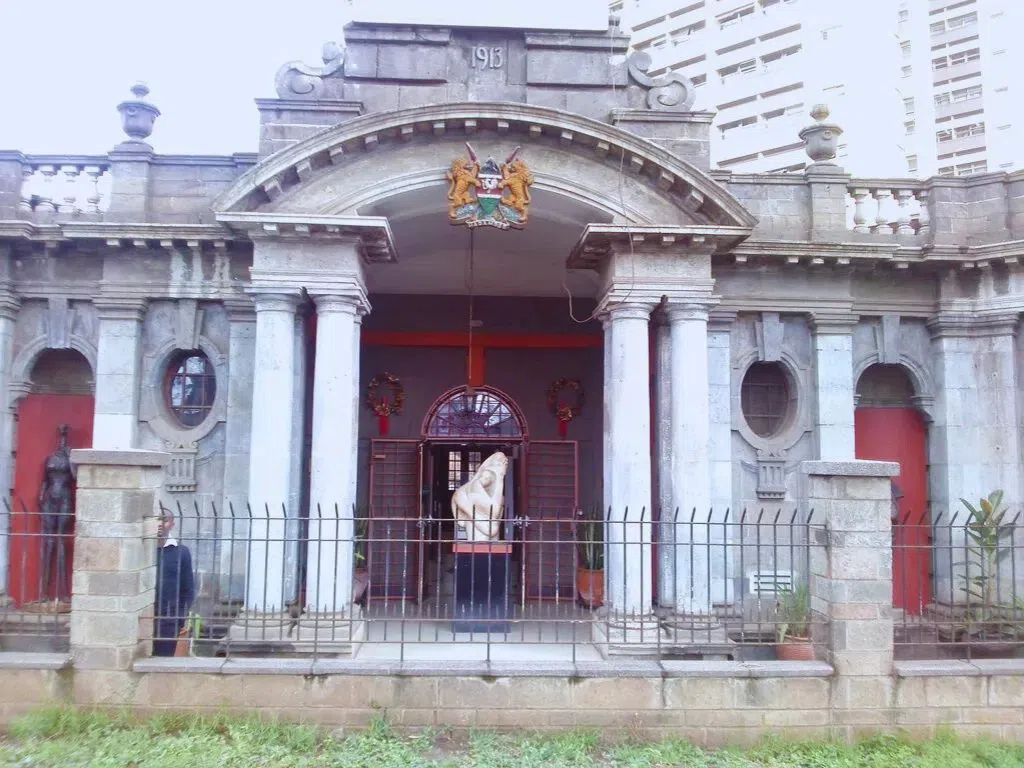
The building now holds the Murumbi African Heritage Collection, assembled by Kenya's second vice-president, and the collection reframes the colonial era rather than celebrating it. The textiles, jewellery and West and Central African objects are the point of the visit as much as the architecture. It is a National Museums of Kenya site, staff guides are available on request, and groups are accommodated without fuss. Non-resident adult entry runs around KES 1,200 (roughly £7) under the May 2026 rates, though confirm at the desk, since they move. Entry is eCitizen or card only and cash is refused outright; travellers turn up with notes and get turned away, so have a card or the eCitizen app ready. Budget an hour, ninety minutes if you read the labels, which you should.
Two hotels that filled with people stepping off the train
Five minutes' walk northeast puts you at Sarova Stanley (central business district, Kimathi Street at Kenyatta Avenue), which opened in 1902, three years after the railhead arrived, as Kenya's first luxury hotel. The pavement courtyard of its Thorn Tree Café is reputed to stand on the site of the city's first post office, the boomtown's communications hub and its gossip exchange, which in a railway town were the same institution. The café takes walk-in groups all day and the hotel has full banqueting and meeting space, but book ahead for parties over eight at peak lunch, when the courtyard fills with people doing business. Mains run roughly KES 1,500 to 3,000, rooms £150 to 270 a night. As a daytime stop it is the better of the two historic hotels: street-level, unceremonious, and you can sit over one coffee without anyone minding.
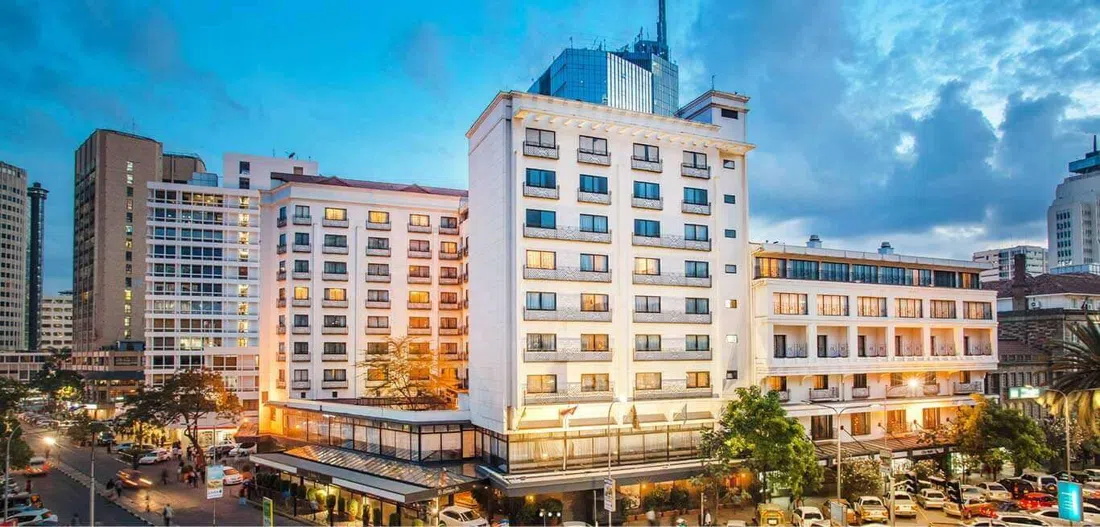
Fifteen to twenty minutes north on foot, or a short ride if the heat is up, brings you to Fairmont The Norfolk (Harry Thuku Road, on the university edge of the centre), which opened on Christmas Day 1904 for exactly one reason: to house the people the new railway was depositing in a town with nowhere to put them. It is still trading 121 years later, refurbished in 2022, and the Lord Delamere Terrace is where the railway town conducted its business, from deals and land claims to safaris outfitted on credit. It is the one railway-era interior in the city you can occupy all evening. Terrace coffee or a drink starts around KES 800, and rooms are £230 to 400 a night. Groups are easy here, with dedicated meetings facilities and a terrace that seats large parties, though you should reserve for dinner. Smart-casual is expected and enforced without any fuss: no beach wear, no flip-flops. You are paying for continuity and a courtyard, not for the most modern rooms in the city. For a couple at sunset or a group of eight who want to linger, that trade is worth making. If you would rather sleep inside the story than visit it, compare rates across the centre with a Nairobi hotel search.

A working railway line across the second hole
The most literal image on this route is a ten-minute ride south of the centre at Kenya Railway Golf Club (Railways, off Haile Selassie Avenue), founded in 1922 by the Railway Manager's wife as the Kenya & Uganda Railway Golf Club. The course is nine holes and the line the club was named for runs straight through it: a train crosses hole two, as it has for a century. Nowhere else is the relationship between city and railway as plain to see.

Unusually for a historic club, visitors are welcome every day without a member to sign them in. Green fees are KES 850 for nine holes or KES 1,350 for eighteen on weekdays, KES 1,750 at weekends. Societies and corporate fourballs are the club's bread and butter, so a group is a normal booking rather than an imposition, but ring +254 776 162 044 ahead, because nine holes jam quickly at weekends and an unannounced party of twelve will wait. Non-golfers are not wasting their time: the members' bar is a plain, unreconstructed room where you can have a drink and watch the crossing. Ask about club hire when you call.
One caveat, and it is the reason to go sooner rather than later. The club has lost land to encroachment over the decades and remains under pressure. What survives is a century-old layout on expensive ground in a growing city, and the arithmetic is not in its favour.
Where the embankment is the main street
About seven kilometres southwest of the centre, the original line runs through Kibera, and the raised track bed doubles as the settlement's main street, market and best vantage point. It is the most alive section of the whole route and the one place on this itinerary you should not attempt alone, not as a matter of nerves, but because it is a dense residential area with its own etiquette, uneven footing, and trains that still use the rails.
Go with Explore Kibera Tours (Kibera), which has been running since 2009 and is rated 4.9 to 5.0 across hundreds of 2026 reviews. The guides and security staff were born and raised there, so they explain the place rather than walk you past it. Groups are kept small, typically up to six, with larger parties split across several guides, and you book by WhatsApp or through the website. Expect around £25 to 40 per person for a three-to-four-hour walk, part of which funds a Kibera school. Bring a hat and water, wear shoes you can trust on loose ballast, and take your lead from your guide on photography: ask first, every time. This suits travellers who are prepared to listen for three hours rather than people who want pictures of themselves.

The downtown grid, told by the men who live on it
The blocks the railway surveyors laid out are also where the city's own story is least documented, and Nai Nami (central business district) fills that gap. The walk is led by men who grew up on these streets and tells the downtown blocks through their own lives, with a candour no heritage plaque attempts. It is the human layer over the stations, avenues and monuments the rest of this route covers.

The format is intimate by design: one guide for every one or two guests, so a party of eight arrives to find four guides waiting and splits accordingly. Walks run two and a half to three and a half hours and include a local lunch and soft drinks, and USD 37 per person covers everything. Lead times run to weeks, so this is the one booking to make before you fly rather than on arrival. Pair it with Nairobi Gallery on the same day: the museum supplies the official version of the city's founding, and this supplies the one that followed.
Both gauges in a single glance
Finish, if you have the appetite for a drive, at Nairobi Terminus (Syokimau, about 25 km southeast of the centre off Mombasa Road toward the airport). This is the standard-gauge railway terminus that opened in 2017 and took the Mombasa traffic off the old Uganda line. It was built alongside its metre-gauge ancestor, so you can see both gauges, a century apart and running parallel, in one glance. Nothing here is heritage, and this new line is the reason the old one is quiet.
It is a full public terminus with group ticketing and large waiting halls. Book through the Kenya Railways ticketing portal, not at the gate, and arrive an hour before departure because airport-style screening applies. Fares to the coast run from around KES 1,000 in economy to KES 4,500 in first class. Be realistic about the detour: it is 40 to 60 minutes each way in traffic, so make the trip if you are actually boarding a train, or if the comparison between old line and new is the part of this subject that interests you most. If it isn't, spend the afternoon on the Lord Delamere Terrace instead.
Practical notes
Getting around. The centre is compact and the Gallery to Stanley to Norfolk triangle is a comfortable walk in daylight. After dark, take a ride-hailing app, which is cheap and universal here: expect a few hundred shillings for a hop inside the centre, and KES 1,500 to 2,500 out to Syokimau. Matatus run everywhere and cost almost nothing but are not a sensible first-day experiment with luggage or a camera.
Cash and cards. Carry both. Nairobi Gallery is card or eCitizen only and refuses cash outright, while the golf club, small operators and anything street-level prefer M-Pesa or shillings. Tour fees quoted in sterling or dollars are typically settled by transfer or mobile money on the day.
Timing. At 1,795 m the city is mild rather than hot, and the evenings cool off properly, so take a layer for the terrace. The driest stretches are January to February and July to September; the long rains fall March to May and the short rains from late October. Walk Kibera in the morning before the heat, and keep the golf club for a weekday if you want the course to yourself.
Budget. A two-day version of this route, excluding accommodation, comes to roughly KES 13,000 to 19,000 per person: entry at the Gallery, a round of nine or eighteen, a courtyard lunch and a terrace drink, the downtown walk and the Kibera walk. Rates shift, so confirm when you book. For wider context on where to stay, eat and go next, the Nairobi guide covers the rest of the city this railway happened to invent.